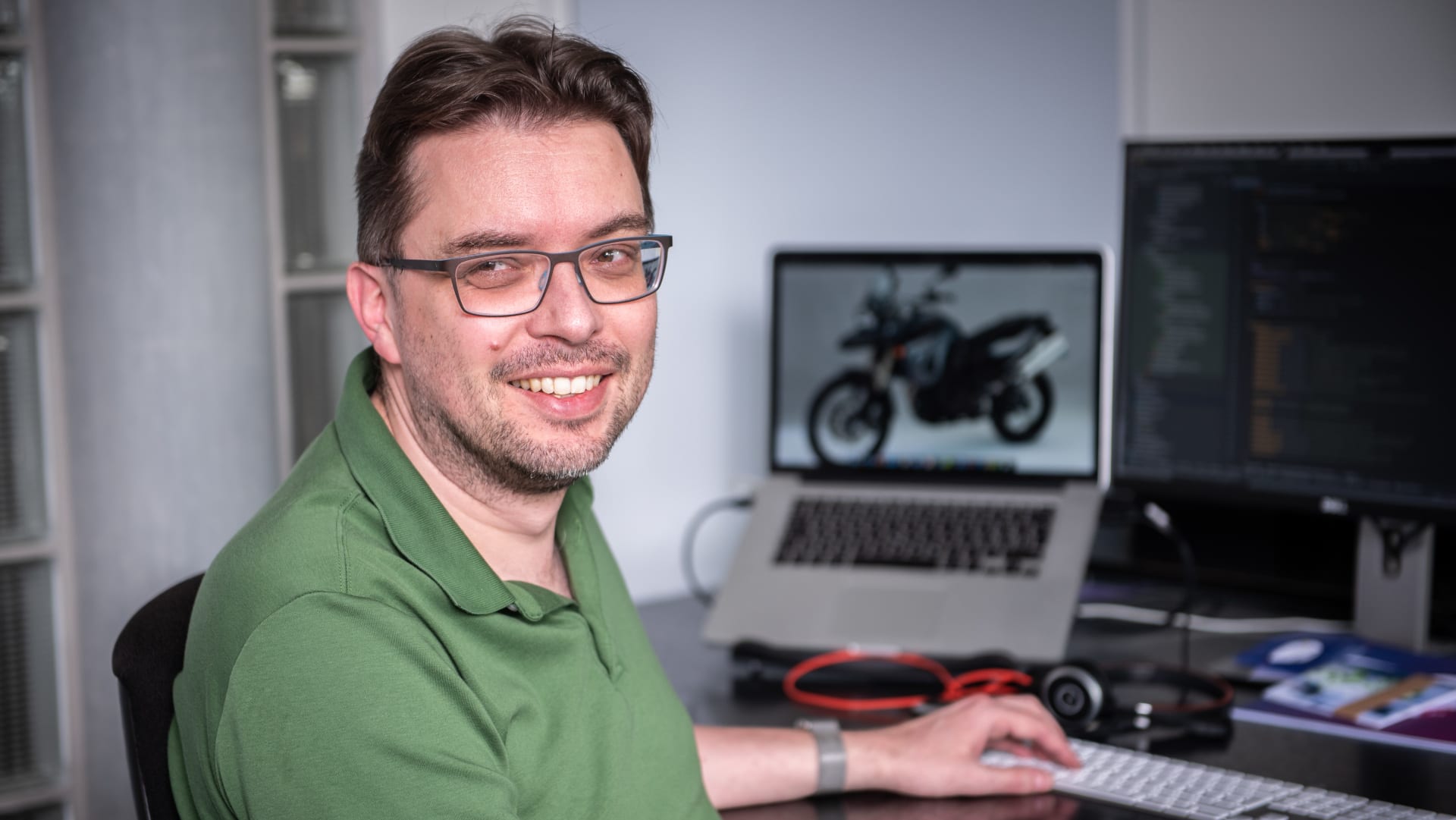


Gerald Wilhelm is an Expert Application Architect at Unic and has been for over 17 years. During this time, he has worked with a wide variety of e-commerce and web solutions.
He currently leads the technical development of a project in the technically demanding B2B industry with a high e-commerce and supply chain component, implementing complex digital solutions for international industrial processes. As a Technology Strategist, he helps us position Unic correctly for the coming years.
You Never Stop Learning
Gerald is one of those people who constantly expand their horizons and learn new things with enthusiasm. Keeping track of things in the fast-moving IT world is a challenge. This is made even more difficult by the marketing departments of individual manufacturers. Gerald quickly recognizes the core of the matter. We often hear him say: "Actually, that's just...", followed by an analogy to a technology familiar to his counterpart.
Gerald, what fascinates and motivates you in your daily work as an Application Architect & Engineer?
What I enjoy most is being able to deal with technical problems – primarily in the area of software development at Unic. The trickier the problems are, the deeper I can dig around in the code, the better. Sometimes I forget the time, or I look at my colleagues somewhat confused when they address me while I'm working on a problem.
With many customer projects, we get to build a completely new solution "on the green field". Developing a suitable software architecture for this is one of my interesting tasks. To obtain all the necessary information for effective technical implementation, I have to communicate intensively with our customers. Even during and after our projects, there are many coordination meetings and discussions with contact persons on the customer side.
The trickier the problems are, the deeper I can dig around in the code, the better.
Gerald Wilhelm
Expert Application Architect
Which Trends Are Currently Shaping Your Work?
Composable Architectures are currently my main focus – the composition of a solution from individual services. This approach allows us to realize solutions much more flexibly and efficiently.
Supply Chain Attacks like Shai Hulud have become very important lately, involuntarily, and we had to react very quickly. Such security incidents show how critical securing our software supply chain has become.
You can't avoid AI these days, whether you like it or not. In some situations, I've had very good experiences with it, but sometimes it completely misses the mark. You just have to stay critical and not trust blindly.
All these technologies find their way into my daily project work at Unic.
How do you manage to always stay at the forefront technologically?
Reading a lot, informing myself, and trying out interesting things – "getting my hands dirty". Often it's more crucial to know that something is possible at all than the "how". You can then deal with the "how" when you know what you want to do, i.e., when you've found a concrete goal among the many possibilities.
Active Contributions to the Community and Diverse Customer Projects
Which communities do you use to share your knowledge and learn new things?
The usual suspects for a software engineer are still important to me: Stackoverflow, Github, Gitlab, Reddit, forums of OSS projects, etc. But increasingly also interaction with chatbots – though with the necessary critical restraint, as I mentioned earlier.
How is the work at Unic shaped by this Open Source Community?
All my work depends heavily on the excellent projects of the Open Source Community. Unfortunately, my circle currently has no active open source projects.
What distinguishes software engineering at Unic from your perspective?
Three aspects are particularly important to me:
The opportunity to work with technically very experienced and competent colleagues.
The relatively great freedom to use the tools necessary for excellent implementation of our customer projects.
The chance to participate in very diverse customer projects.
What would you not want to do without in your daily work?
As banal as this may sound: the internet. The fast and diverse access to knowledge is phenomenal, even if superficially it seems to be primarily about cat videos and self-presentation. Although I see myself more as an information seeker than a real digital native.
How would you describe your current challenges?
On an important project, time is getting tighter due to delays from a supplier, and some fundamental points still need to be clarified. But I'm an incorrigible optimist – we'll manage it.
How do you assess the influence of Holacracy on your daily work?
More freedom, but also more responsibility. Decisions are made in a structured way and thus become more transparent and comprehensible. The typical phrases from Holacracy meetings "Do you have everything you need?" and "Yes, I have everything I need" are also used outside of meetings. So they seem to promote more clarity. My initial skepticism towards Holacracy has decreased over time.
What changes in web development in general have you noticed over the past few years?
More and more business logic is moving from the middleware to the browser, i.e., to the client, but also partly to the database. The middleware is getting thinner and lighter. Developments in the frontend are incredibly diverse and rapid. Sometimes frameworks or approaches become obsolete after just a few weeks.
How would you describe teamwork @ Unic?
Especially in the "Web Experience" circle in Bern: Rough, but warm-hearted. On the wall hangs the saying: "If you're being teased, you're part of the team!" – although I definitely don't feel bullied! On the one hand, the team in this circle has a greater tendency for mutual teasing than I've experienced in other circles, but on the other hand also a greater tendency for technical discussions at a very high level than I've experienced in other teams and circles. In general, I feel very comfortable at Unic – otherwise I probably wouldn't have been here for more than 17 years.