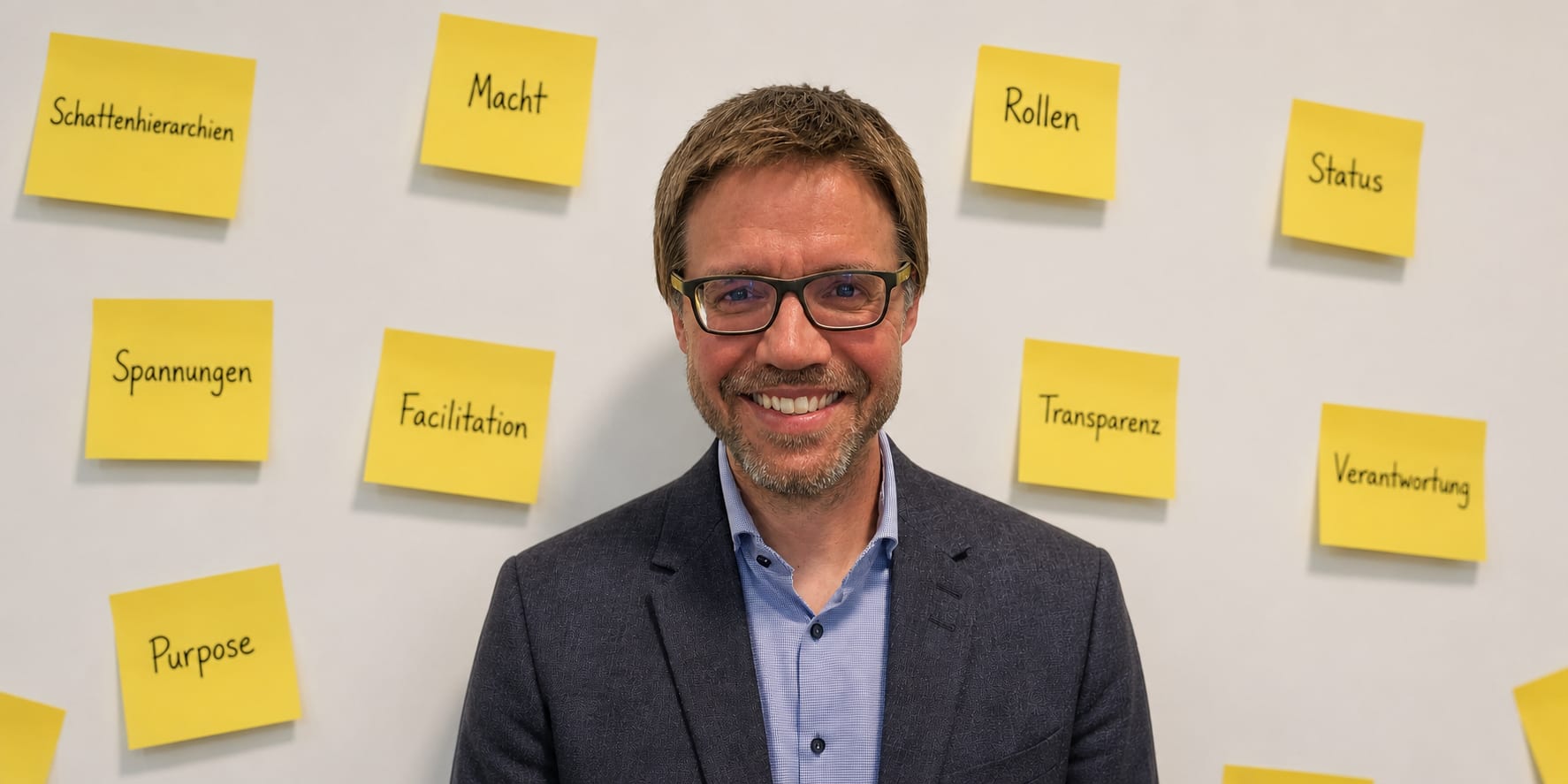
Self-organization doesn't run on autopilot


Sandro Dönni
Power doesn't disappear when you abolish hierarchy. It retreats into the informal. And there, it's harder to grasp than ever before.
This article shows you how to recognize such informal patterns, why they matter, and what helps in everyday life to address them.
In Brief
Power does not disappear in self-organized structures – it shifts to the informal level.
Shadow hierarchies emerge through affiliation, networks, reputation, and informal communication spaces.
It becomes problematic when influence is no longer transparent, approachable, or shapeable.
The structured meetings of self-organization are the central tool for making influence visible.
The most important step: address patterns early, concretely, and without blame.

How do shadow hierarchies emerge in self-organized organizations?
Even when roles and decision-making processes are clearly defined, influence in everyday life does not arise through formal channels alone. This is precisely where informal patterns emerge that can be more powerful than the official structure.
What are shadow hierarchies?
Shadow hierarchies are informal power and influence structures that operate alongside or beneath the official organization. They do not arise through roles or formal decisions (governance), but through factors such as:
long-standing membership or organizational knowledge
personal networks and proximity to decision-makers
professional reputation or rhetorical strength
informal communication spaces
similarity in background, demeanor, or perspective
Why are shadow hierarchies so effective?
Because they are invisible – and because they often come with good intentions: efficiency, protecting the whole, experience, responsibility. This very invisibility makes them difficult to address, particularly for employees who are not yet part of informal networks. Such structures therefore have an excluding effect, even when no one consciously intends to exclude anyone.
How do shadow hierarchies manifest in self-organized structures?
Holacracy – the self-organization model that Unic has been practicing since 2017 – creates clear roles and decision-making spaces. Yet even here, such patterns often appear subtly: decisions are informally prepared, tensions resolved bilaterally, or initiatives quietly discouraged. This easily creates a gap between the aspiration for co-creation and the actual experience.
It becomes problematic where influence is no longer transparent, no longer approachable, and no longer shapeable. What matters is whether informal structures make participation more difficult, silence individual voices, or stifle good ideas. For self-organized companies, this is particularly relevant because such dynamics contradict the commitment to distributed responsibility and shared decision-making.
Who experiences these dynamics – and who does not?
Not everyone experiences an organization in the same way. Some people feel a great deal of room to shape things, while others are more aware of invisibility, barriers, or informal influence.
These differing perceptions are not a contradiction that needs to be resolved. They are an indication that experience depends strongly on context, role, background, networking, and psychological safety. Anyone who wants to strengthen self-organization should create spaces where experiences can be named, tensions raised, and patterns reflected on together.
What can you do about it?
Self-organization provides us with effective tools – but only if we actively use them:
Raise tensions where they belong. The designated formats of self-organization – at Unic, these are Tactical and Governance Meetings – are not a formality. They are the central means of making influence visible and shapeable. Unused formats are the breeding ground for informal power.
Make influence explicit. When someone strongly shapes or steers things, it is worth asking: in what role? With what purpose? With what mandate? Transparency reduces informal influence.
Understand facilitation as a protected space. Good facilitation ensures that volume, status, or routine do not dominate – but rather the process. It protects quieter voices in particular.
Name power rather than taboo it. Self-organization is not a power-free system. But it only works well when we make power visible, discussable, and distributable.
Speak up when it arises. If you notice such dynamics, it helps to address them early, concretely, and in the appropriate setting – not as an accusation, but as a contribution to shared development. Only then does it become possible to understand different perceptions, make blind spots visible, and continue developing your own form of self-organization.
An invitation to reflect
Those engaged with self-organization might ask themselves the following questions:
How well do you know the tools your organization provides for raising tensions?
How often do you actually use them?
What holds you back?
And what do you need to do it more often in the future?
Shadow hierarchies are not a personal failure and not evidence against Holacracy. They are an indication of where we as an organization still have room – and a responsibility – to learn. When we make them transparent, we can shape things together and harness the potential of all employees. This sometimes takes a little courage and the willingness of everyone to get involved and shape the future together.
Power does not disappear when hierarchies are removed. But it becomes shapeable. And that is the decisive difference.
-- Sandro Dönni, Principal Transformation Consultant




We look forward to hearing from you!
Share