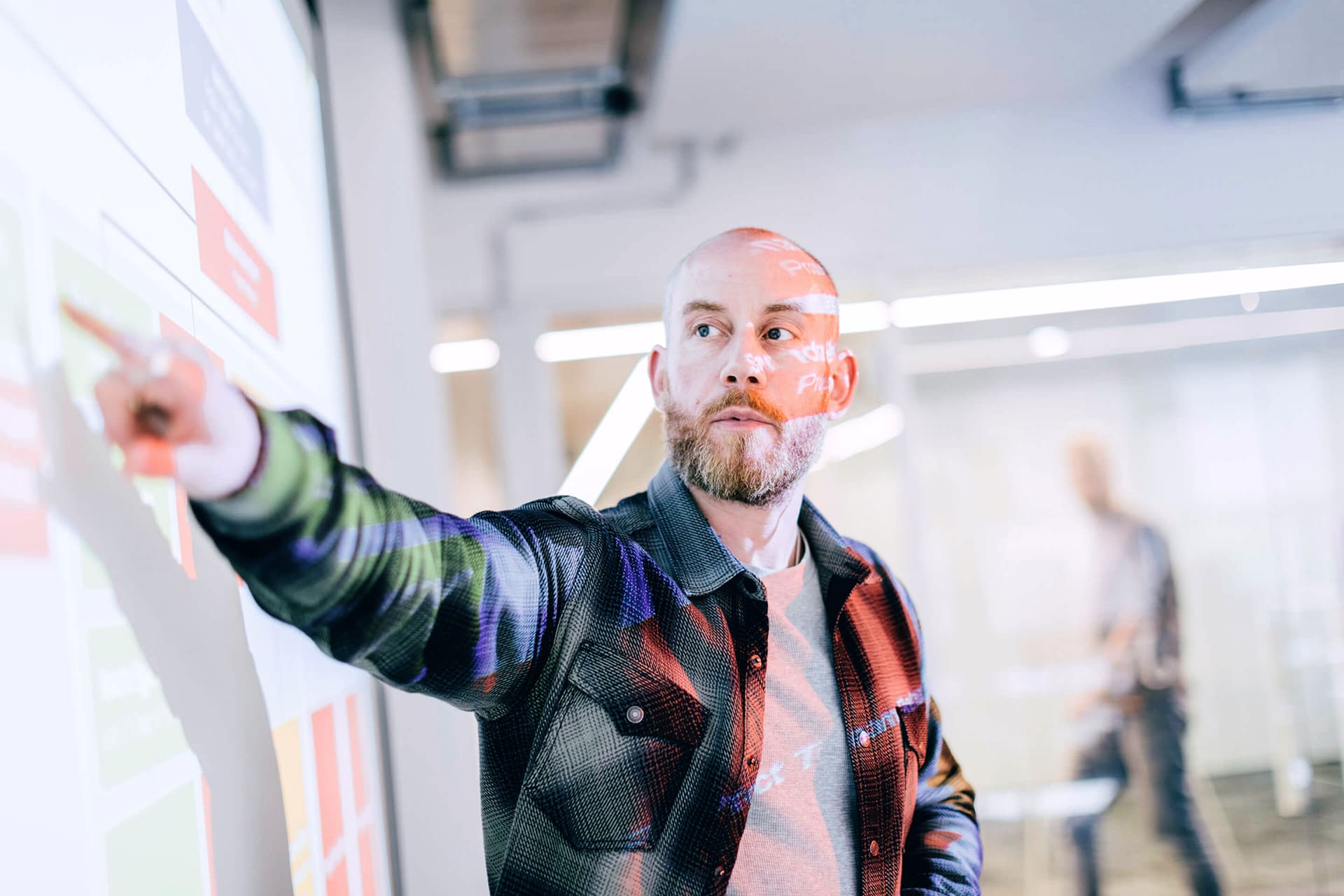


Why do we do what we do, and what does that have to do with customer experience?
For us, every answer starts right there. Customer experience is not the end result of a project, but the starting point of our thinking. Our ‘Why, How, What’ encapsulates this philosophy. It is not a communication model, but our internal framework, and it makes one thing clear: for us, customer experience is not a service. It is an attitude.
Why "Why, How, What"?
In 2006, Simon Sinek put forward a simple yet powerful thesis: successful organisations start with the ‘why’, not with the ‘what’ or the ‘how’. The ‘why’ is not just mission statement rhetoric. It describes a conviction. The reason why an organisation exists. The inner drive behind decisions. We have adopted this model and developed it further. Today, our Why, How, What is not an external narrative, but part of our identity. It forms the basis for how we design, evaluate and further develop digital experiences. And above all, it ensures one thing: people remain the starting point for every decision.
People aren't interested in who you are and what you do. They want to know why you do it.
Simon Sinek
Our framework fulfils three key functions:
Guidance – decisions can be consistently measured against our purpose
Differentiation – our ‘why’ sets us apart in a substantive, not merely superficial, way
Connection – a shared conviction, embraced by everyone at Unic
Why – We make digital human
That is our purpose. Not just a slogan, but a mindset. Customer experience is our guiding star, setting the direction for every decision we make. We firmly believe that the best digital experiences don’t stem from technology, but from a genuine understanding of people. Technology is a means to an end. Not the end itself.
What does that mean in practical terms?
We focus on impact, not features
A poor example would be: “We’ve built a React application with a headless CMS.”
What matters is: “People now find what they’re looking for in two minutes instead of eight.”
We measure success by results, not by activity
30% higher conversion rates
40% fewer support enquiries
50% faster time-to-market
These aren’t just marketing figures. They’re the basis for decision-making.
We develop solutions that people actually want to use
Technical excellence is a prerequisite, but it is never enough. A solution must be easy to understand. It must break down barriers. It must provide reassurance. And it must stand the test of everyday use.
A practical example from our work
In a major e-commerce project, we radically simplified the checkout process. Returning customers can place an order with a single click. New customers now need to fill in just five fields instead of thirteen.
The result:
+30 % conversion rate
significantly better qualitative feedback
This isn’t just a minor UX detail. It’s customer experience with a measurable impact.
How – Our Approach
For us, customer experience is not an abstract concept, but the benchmark for our day-to-day actions. It serves as our guiding star: in collaboration, decision-making and prioritisation. Our purpose only works if it is consistently put into practice. The following four principles therefore shape the way we work.
1. Culture – attitude over method
We operate within an open, respectful culture of communication. For us, diversity is not an ideal to strive for, but a reality. Appreciation is not just a buzzword.
In practical terms, this means:
We listen before we make recommendations
We speak our minds – clearly, constructively and honestly
We work as equals – both internally and externally
When launching projects, we deliberately bring together different perspectives: strategy, UX, technology and the customers themselves. Because better solutions don’t come from working in silos, but from collaboration.
2. Self-organisation – decisions made where the expertise lies
We operate on a self-organised basis, following the Holacracy model. Not out of ideology, but out of conviction. Decisions are made where the knowledge lies – not where hierarchies end.
This leads to:
faster decision-making
greater responsibility
adaptive teams
When a UX issue arises, the design team makes the decision. Not management. This saves time and improves quality.
3. Processes & Standards – Clarity where it matters
TQMI (Total Quality Management Integration) provides us with structure. But we are not process purists.
Our principle: as much structure as necessary. As much freedom as possible.
Code reviews are standard practice. The team decides on the format: pair programming, a brief review or an in-depth analysis – depending on the context. For us, process is not an end in itself. It serves quality. Not the other way round.
4. Looking to the future – making room for what lies ahead
We are actively shaping the trends of tomorrow: AI, sustainability, new ways of working.
We make a conscious effort to create space for this:
Time for in-house initiatives
In-house programmes on new technologies
Collaborations with universities and start-ups
We started experimenting with generative AI early on. Today, we integrate AI where it delivers real added value and measurably improves the customer experience.
What – What we offer
Customer experience is the common thread that runs through everything we do. It brings together strategy, design, marketing and technology to form a coherent whole. We develop digital experiences that captivate people and drive businesses forward.
1. Strategy & Consultancy
A clear direction. Well-informed decisions.
We help organisations prioritise the right digital initiatives – ones that are feasible, scalable and effective.
Your added value:
clear decision-making criteria
measurable ROI scenarios
strategies that can be implemented internally
2. Experience Design
When people come first.
We design experiences that are intuitive, break down barriers and are used in the long term.
Your added value:
30% higher conversion rates thanks to optimised user journeys
40% less support required thanks to intuitive interfaces
Design decisions based on real user needs
3. Digital Marketing
Relevance rather than reach.
We develop data-driven, personalised marketing strategies with measurable results.
Your added value:
25% lower acquisition costs thanks to precise targeting
Higher customer lifetime value through relevant communication
Automation that takes the pressure off – not adds to the complexity
4. Solution development
Technology that grows with you.
We build scalable, flexible architectures that can be developed further – without having to start from scratch every time.
Your added value:
50% faster time-to-market
Systems with true autonomy
Reduced technical debt
How we put our framework into practice
Our Why, How and What aren’t just words on a wall. They guide our day-to-day decisions.
In customer service
Before we suggest a solution, we ask: Why do you need this? What problem are we actually solving? Only then do we discuss the how and the what.
Here’s an example: A client wanted a new website. During our discussion, it became clear that the real problem was the high bounce rate at the checkout stage. So that’s where we focused our efforts – with measurable success.
In development
We don’t just develop features. We ask: How does this feature influence the user experience? Does it make the solution better for people?
For example: instead of 20 filter options, we’ve developed 5 that are genuinely useful. Users can find what they’re looking for more quickly. The technical complexity is lower.
In terms of internal organisation
We organise ourselves into Circles (Holacracy). Each Circle has a clear purpose. And the autonomy to put that purpose into practice.
For example: The ‘Experience Design Circle’ makes its own decisions regarding design processes and standards. This makes us more efficient and leads to better results.
What sets us apart
Many people talk about customer experience. Few put it into practice consistently.
For us, CX is not a service
It is an attitude. An interdisciplinary responsibility. One that is ingrained in our DNA.
This means: designers focus on performance. Developers focus on usability. Strategists focus on the emotional impact. Everyone focuses on people.
We work in a modular and interoperable way
Do you just need UX research? Or a complete transformation? We adapt to your needs – not the other way round.
That means: no rigid packages. No vendor lock-ins. Just a genuine partnership.
We’re talking about impact, not features
30% more conversions. 20% lower support costs. These are the figures that matter. Not the number of technologies used.
In other words: our project references demonstrate business impact. Not just technical details.
Progress rather than stagnation
Our framework is not set in stone. It evolves alongside us.
What has become clearer:
CX as an explicit approach across all areas
A more modular, interoperable offering
Focus on business impact rather than feature descriptions
Forward-looking approach as an integral part of our methodology
What remains:
Our purpose: We make digital human.
Our belief: People first.
Our approach: self-organised, process-oriented where appropriate, forward-looking.
Conclusion
Our Why, How and What serve as our compass. They ensure that our work remains relevant – for people as well as for organisations.
For our clients, this means working with a partner who knows why they do what they do. A partner who doesn’t just build solutions, but creates experiences that make a real difference.
For us, it means: Clarity. Direction. And the ability to measure every decision against our purpose.
Truly innovative solutions emerge where empathy meets technology – and where we are prepared to keep evolving.
Lorenzo Mutti, User Experience Director, Unic

Contact for your Digital Solution with Unic
Book an appointmentAre you keen too discuss your digital tasks with us? We would be happy to exchange ideas with you.


Contact for your Digital Solution
Book an appointmentAre you keen to talk about your next project? We will be happy exchange ideas with you.