
Green Betty: A feature that works at the moment of decision


Carmen Candinas
Betty Bossi has established sustainability as a permanent feature on bettybossi.ch with "Green Betty". For this, the company was awarded the Digital Commerce Award in the "Sustainability Feature" category.
Environmental compatibility directly in the recipe
The "Green Betty" feature shows directly within the recipe how environmentally friendly a dish is. Each main course receives a score on a scale of 1 to 5, scientifically grounded in the life cycle assessment of the Zurich University of Applied Sciences (ZHAW).
Project manager Stephanie Wüthrich explains in an interview how Green Betty was integrated into the customer journey and what other teams can learn from it.
Betty Bossi won the Digital Commerce Award in the "Sustainability Feature" category. What does this recognition mean to you?
Stephanie Wüthrich: Green Betty is a passion project for a great many people at Betty Bossi. The award means a lot to us, especially because sustainability is currently receiving somewhat less attention in many places. For us, however, the topic remains central – for our customers as well as for our environment.
You have firmly embedded sustainability into the product rather than limiting it to a campaign. What makes Green Betty different?
We deliberately wanted to avoid anything theoretical. There are already enough websites explaining what people should eat – the problem is that this is rarely something that can be integrated into everyday life. We wanted to create a tool that helps exactly where it is needed: in the recipe. Information and comparability rather than pure knowledge transfer – that is what sets Green Betty apart.
We wanted to create a tool that helps exactly where it is needed.
-- Stephanie Wüthrich, Project Manager Green Betty
And why is this particular moment so crucial?
On the recipe page, people decide whether they are going to cook the dish. That is precisely where the information needs to be – appearing at the right moment and supporting environmentally friendly meal planning. With our large reach, every small decision has the potential to make a significant difference in the aggregate.
What does this look like in practice – what does a user actually see?
Each main course receives a score on a scale of 1 to 5 green dots. 1 corresponds to the current average of the Swiss diet, while 5 represents the ecological ideal. Anyone who regularly cooks recipes with 2 or more dots is already eating more sustainably than average. At 4 or 5 dots, you are already doing very well.

How did you ensure that Green Betty is not perceived as a judgment or an accusation?
This was very important to us from the very beginning: Green Betty should not come across as preachy or negative. The first sketches still featured red and orange dots for low scores – a classic traffic light logic. We deliberately rejected that approach. We do not want to create a guilty conscience; we want to inspire a sense of discovery. Enjoyment with a future, not deprivation.
Did you test this with users?
Yes, we conducted many user tests, interviews, and surveys. These revealed that labels are polarising. As soon as something feels judgmental, you lose people – they react with rejection, and the opportunity is quickly gone. Incidentally, before we even arrived at a dot-based scale, we wanted to use leaf icons. However, these caused confusion and rejection in tests, particularly among people who enjoy eating meat.
Are there other measures besides Green Betty through which Betty Bossi promotes sustainability in the user experience?
We actively promote recipes that are popular and perform quite well in terms of sustainability – such as Älplermagronen or Spaghetti Carbonara – and rely on many entry points: through recommendations, filters, or the weekly planner. It is hard to miss the topic of sustainability. Using targeted nudging strategies (gentle behavioural guidance through design), a ribbon (a visual label on the recipe tile) automatically appears on sustainable top recipes, highlighting the sustainable recipe even more prominently, along with further recommendations for sustainable recipe collections.
Do you receive feedback on whether Green Betty actually changes behaviour?
Measuring behavioural change is very difficult. Our goal is for sustainable recipes to become favourite recipes – not through active effort, but because the offering is simply good. We measure interactions with buttons and filter pages, run A/B tests, and analyse customer service enquiries. The response has been very positive.
What has surprised you most since Green Betty went live?
That some users do not entirely trust the ratings. This shows how deeply ingrained food myths are: many people believe that anything vegan is automatically sustainable – or that a recipe containing a bit of bacon cannot possibly be sustainable. The Älplermagronen generated quite a few queries for that reason. Internally, what surprised me most was how much enthusiasm the project has sparked: everyone is a big fan, and Green Betty spreads by itself across all channels. As a result, we are now also planning more actively with recipes that have a positive score in our content planning. And our recipe editorial team is already taking this into account when developing new recipes.
What would you advise someone who wants to integrate sustainability as a genuine feature into their platform?
Data over gut feeling. Usability tests and interviews are incredibly valuable – make use of them.
Don't be preachy. Offer guidance rather than moralising, and don't ask users for extra effort – everything must be accessible simply and without going the extra mile.
Working interdisciplinarily brings a change of perspective – product development, developers, life cycle assessment experts, the recipe editorial team, and communications all need to be on board.
Data over gut feeling. Usability tests and interviews are incredibly valuable – make use of them.
-- Stephanie Wüthrich, Project Manager Green Betty
Where should Green Betty go in the future?
Our goal is for sustainability to eventually be considered as a matter of course when choosing recipes – just like cooking time or difficulty level. If Green Betty contributes to that, we will have achieved a great deal. We therefore want above all to raise Green Betty's profile and reach users even more effectively at their decision-making moments. The next step is to bring the feature to the Betty Bossi recipe app. In the medium term, we still have quite a few items on our wish list. For example, a swap button: users could use it to exchange individual ingredients directly within the recipe for more sustainable alternatives.
And we dream of visually displaying the environmental impact per ingredient, so that at a glance you can see what really makes a difference in a recipe. Ultimately, our goal is to create something practical with real impact. With over two million users, the leverage is enormous – and we take that very seriously.
Stephanie Wüthrich, Project Manager Green Betty
She leads the "Green Betty" project at Betty Bossi – the scale that makes the environmental compatibility of recipes on bettybossi.ch visible, developed in collaboration with ZHAW. For this, "Green Betty" was recognised as a "Sustainability Feature" at the Digital Commerce Award 2026. Wüthrich lives in Zurich and studied at HWZ University of Applied Sciences in Business Administration Zurich.


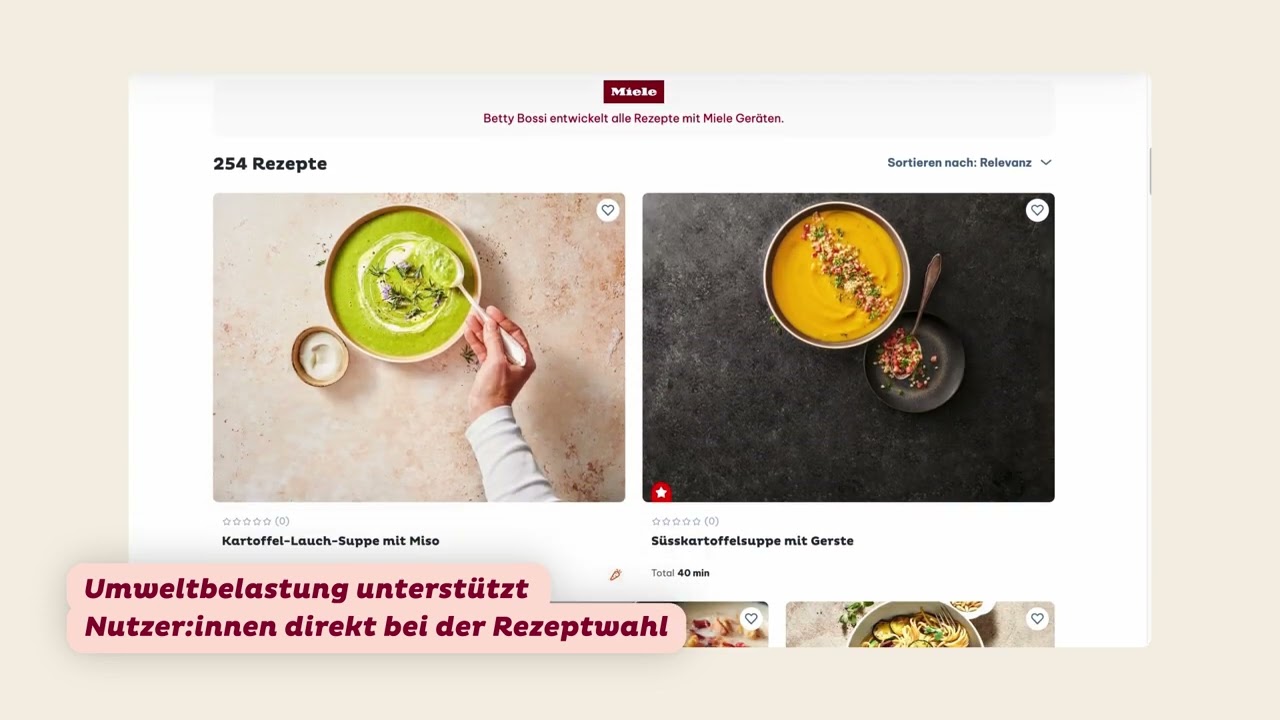
This video is hosted on YouTube.
I agree to external content from You Tube being displayed to me. Personal data may be transmitted to third-party platforms in the process. More on this in our Privacy Policy

Contact for your Digital Solution with Unic
Book an appointmentAre you keen too discuss your digital tasks with us? We would be happy to exchange ideas with you.



Contact for your Digital Solution
Book an appointmentAre you keen to talk about your next project? We will be happy exchange ideas with you.



Image: (c) Betty Bossi
Share